Key Takeaways: CPT 96130 and the test administration codes 96136 to 96139 are designed to be billed together, each for its own minutes. Bundling denials usually come from time counted under two codes, a base code billed twice, or a modifier added without documentation to support it. For residential, PHP and IOP programs, whether testing during a stay is separately billable depends on the payer and the contract, so it has to be verified first.
- Evaluation time and administration time are separate pools, and a minute of giving or scoring a test never belongs under 96130.
- A unit counts once more than half its time has passed: at least 31 minutes for an hourly code and 16 minutes for a 30-minute code.
- Psychologist and technician administration on the same day needs XE for separate encounters or 59 for the same encounter, and no modifier on different dates.
- Multi-day testing is billed once at completion, with the base code used only for the first unit of each type of service.
- For facilities, testing during a residential, PHP or IOP stay goes on a professional claim, and whether it pays outside the per diem depends on the payer and the contract.
Contents
- The codes are designed to be billed together
- Where the minutes go wrong
- The modifier problem: 59 is not a default
- Multi-day testing: one episode, one bill
- The other errors behind bundling denials
- What the record needs to show
- For facilities: is testing billable during a residential, PHP or IOP stay?
- Final Thoughts
Your psychological testing claim came back denied as bundled. The codes were 96130 with 96136 or 96138, the services were delivered, and the payer paid one line and rejected the rest, or paid the whole claim short.
The usual next step is to look for the wrong code. That is rarely the problem. The testing codes are designed to appear on the same claim. A complete testing episode carries an evaluation code and administration codes together, and payers expect that. What triggers the denial is usually how the time was split between the codes, or a modifier added out of habit. For a behavioral health facility, a second question comes before any of that: whether testing during a residential, PHP or IOP stay can be billed separately at all.
CPT 96130 is the code for the first hour of psychological testing evaluation services by a physician or other qualified health care professional. It covers interpreting test results, integrating them with clinical data, clinical decision making, treatment planning, the report and interactive feedback. Each additional hour is billed with add-on code 96131.
This guide walks through how the codes fit together, where the minutes and modifiers go wrong, and what a facility should check before testing a patient mid-stay.
The codes are designed to be billed together
The psychological testing codes split into evaluation services and test administration services, and a full testing episode uses both. Evaluation codes pay for the professional’s thinking: selecting tests, interpreting results and writing the report. Administration codes pay for giving and scoring the tests, and they differ by who does the work.
| Code | Service | Performed by | Unit |
|---|---|---|---|
| 96130 / 96131 | Psychological testing evaluation | Physician or qualified health care professional (QHP) | First hour / each additional hour |
| 96132 / 96133 | Neuropsychological testing evaluation | Physician or QHP | First hour / each additional hour |
| 96136 / 96137 | Test administration and scoring, two or more tests | Physician or QHP | First 30 minutes / each additional 30 minutes |
| 96138 / 96139 | Test administration and scoring, two or more tests | Technician | First 30 minutes / each additional 30 minutes |
Two rules sit underneath the table. Administration codes require two or more tests; a single test, even one with many subtests, does not qualify, according to the APA Services testing code FAQ. And a provider should not bill psychological and neuropsychological evaluation codes for the same episode. A 2026 BCBS of Oklahoma coding policy asks providers to decide which type predominates and bill only that one.
Where the minutes go wrong
The most common bundling problem with CPT 96130 is time counted twice. Evaluation time and administration time are separate pools. A minute spent giving or scoring a test belongs under 96136 to 96139, never under 96130, even when the same psychologist does both. When a claim reports more total time than the record supports, or the same session appears under both groups, payers treat it as unbundling.
Units follow the CPT time rule: a unit counts once more than half its time has passed. The Oklahoma Blue policy puts it as at least 31 minutes for an hourly code and at least 16 minutes for a 30-minute code. So 31 to 90 minutes of evaluation is one unit of 96130, and 91 to 150 minutes adds one unit of 96131. For administration, 16 to 45 minutes is one base unit, and 46 to 75 minutes adds one add-on unit.
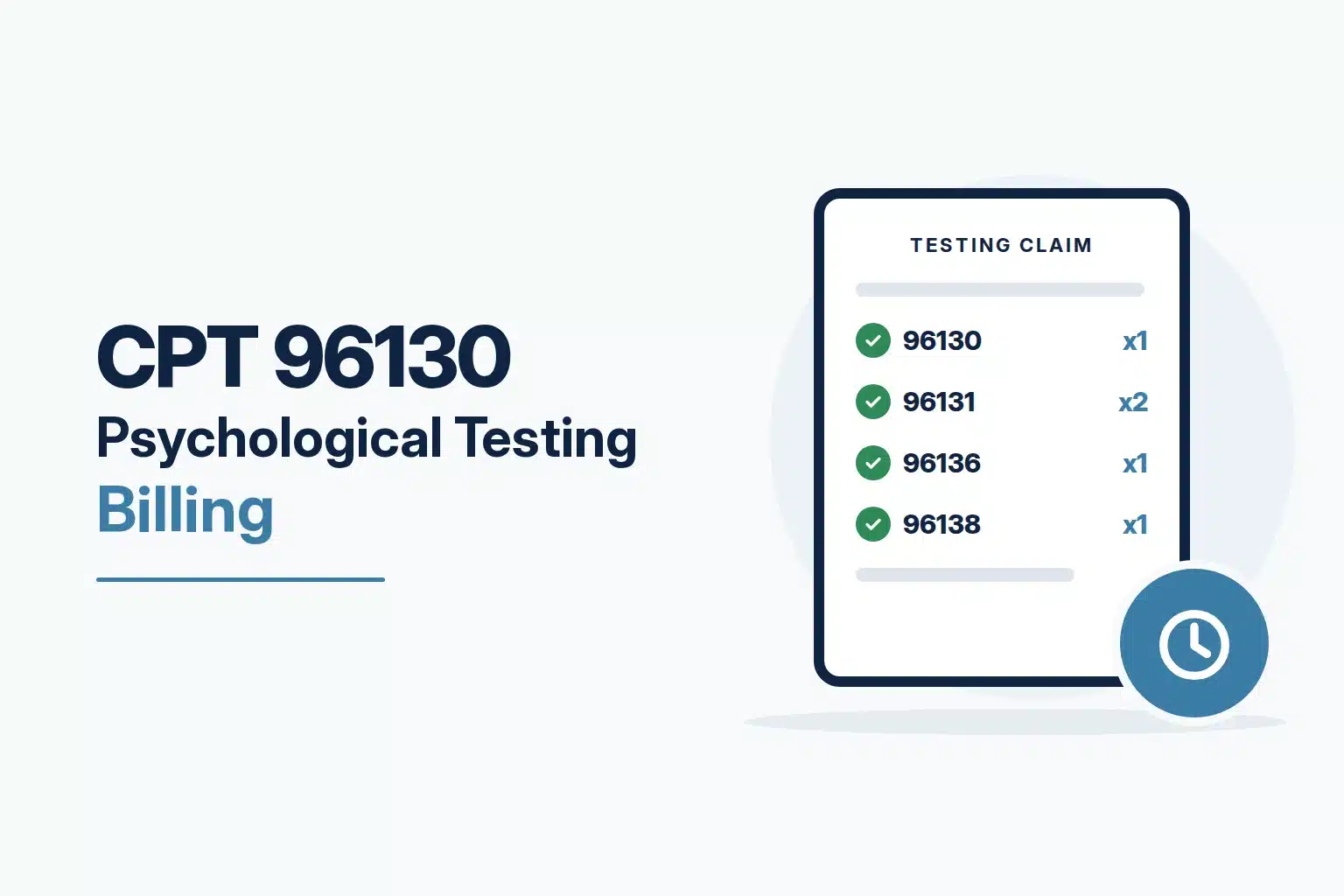
A worked example makes the split concrete. A psychologist spends 50 minutes giving tests on Monday. A technician gives the rest of the battery on Wednesday, taking 95 minutes. The psychologist then spends 160 minutes on interpretation, the report and feedback. The claim carries:
- 96136 x 1 and 96137 x 1 for the psychologist’s 50 minutes of administration
- 96138 x 1 and 96139 x 2 for the technician’s 95 minutes
- 96130 x 1 and 96131 x 2 for the 160 minutes of evaluation
No modifier is needed in that example, because the psychologist and technician tested on different days. Some payers set their own thresholds or unit caps, so check the policy before billing.
The modifier problem: 59 is not a default
The one built-in conflict in this code family is a National Correct Coding Initiative (NCCI) edit between psychologist and technician administration. Codes 96136 and 96137 cannot be paid with 96138 and 96139 on the same day for the same patient unless a modifier shows the services were separate. Many billers respond by adding modifier 59 to every testing claim. That habit causes its own denials, and it can draw audit attention.
APA Services’ updated billing guidance is specific. If the psychologist and technician test at separate encounters on the same date, use modifier XE. If the technician takes over within the same encounter, use 59. If they test on different dates, no modifier is needed at all. CMS also defines modifier XP for a separate practitioner, but APA’s guidance for this edit uses XE and 59.
CodeMax’s billing team follows the same rule. It reviews the NCCI edits for each code combination before billing, and adds XE, 59 or another modifier only when the documented circumstances support it.

Multi-day testing: one episode, one bill
Testing spread over several days is reported once, at completion. APA’s January 2025 guidance says the single bill lists base and add-on codes with their own dates of service. The base code covers only the first unit of each type of service across the whole episode, and later units on any day use add-on codes. Billing the base code again on day two is one of the quickest ways to get a bundling denial. A feedback session is part of the same episode, so its time goes on that single bill as add-on units.
When an organization must bill before the evaluation is finished, the APA FAQ suggests noting each date’s hours with “evaluation ongoing and report to follow.”
The other errors behind bundling denials
Beyond minutes and modifiers, a short list of errors accounts for many testing denials:
- Billing a second scoring pass done for accuracy; APA says scoring is paid once.
- Billing 96136 to 96139 for a single test.
- Billing brief screeners as full testing, when payer policies direct them to 96127 or the automated code 96146.
- Billing technician work under 96136, or supervised trainee work under 96130.
What the record needs to show
A testing claim is only as defensible as its time records. APA calls for comprehensive, transparent documentation of every testing activity. In practice, that means a table in the report listing each date and the total time for each activity, including scoring and clinical decision making. It also means a log in the chart with clear start and stop times, a record of which tests were given and who gave each one, and a written reason for any repeat administration. The report should tie results to the diagnosis and treatment plan, which is what makes the evaluation time defensible.
For facilities: is testing billable during a residential, PHP or IOP stay?
Psychological testing can be billable while a patient is in residential treatment, partial hospitalization or intensive outpatient care, but only when it is medically necessary, separately reportable and covered under the member’s benefit plan. The testing codes do not follow per diem rules. They are reported by CPT code, time, units and date of service on a professional claim (CMS-1500 or 837P), while the facility’s daily rate goes on a UB-04. Whether a payer pays both, or treats the testing as part of the per diem, depends on the payer’s policy and the facility contract. That makes verification the first step, not the last. Before testing a patient mid-stay, confirm the payer’s bundling rules for that level of care, its authorization requirements for testing and any frequency limits. The Oklahoma Blue policy, for example, limits testing to once per calendar year and may review additional claims for medical necessity. The IOP billing guide covers the per diem side.
Final Thoughts
A bundled testing denial feels like a coding problem, so the instinct is to swap codes. Usually the codes were right. The minutes were split badly, a base code appeared twice, or a modifier went on without the documentation to support it.
The fix is a habit, not a lookup: keep evaluation and administration time separate, bill the episode once at completion, and add a modifier only when the record shows separate services. For facilities, one more habit comes first: verify whether testing during the stay is billable before the first session.
Adding testing to a higher level of care? CodeMax’s verification of benefits team confirms covered services and pre-authorization requirements before treatment starts, so testing questions are answered before the first session. Our billing and claims management team checks NCCI edits before every testing claim goes out. Call 866-263-3629 or email info@codemaxmb.com.
You can also speak to a specialist about billing testing during a stay.
Frequently Asked Questions
Prior authorization for CPT 96130 depends on the patient's plan. Many payers require medical necessity to be established before testing begins, and some require formal authorization. Confirm the requirement during benefits verification. Testing billed without a required authorization can come back as a CO-197 denial
A technician's time cannot count toward CPT 96130. Evaluation codes 96130 to 96133 may be billed only by a qualified health care professional licensed to perform the evaluation. People working under that professional's supervision are treated as technicians, and their administration time is billed under 96138 and 96139.
CPT 96127 is not part of the 96130 to 96139 family. It covers a brief emotional or behavioral assessment, such as a standardized screener. Payer policies reserve 96130 to 96139 for comprehensive psychological or neuropsychological assessments and direct screening-only testing to 96127 or the automated testing code 96146.
A repeat administration after an invalid result can be billed when there is clinical justification. APA notes that administration and scoring time was still spent on the first attempt. Document why the test was given again. Evaluation services for interpretation and the report are still billed under 96130 to 96133.