Key Takeaways: CO-197 means the payer found no authorization on file for the service as billed. In residential, PHP and IOP care, that often does not mean nobody asked. It means the authorization stopped matching the claim: the dates ran out, the level of care changed, the provider identifier differed, or a carve-out entity held the approval. The fix starts with comparing the authorization record to the claim, and prevention means checking that match at every point in the stay where it can drift.
- CO-197 tells you the payer could not find an approval that matches the claim line, not that no approval was ever requested.
- Remark codes N54, N351 and M62 narrow the cause, and CARC 198 means an approval exists but the billed days or units exceed it.
- Under the CO group code, the provider absorbs the adjustment and cannot bill the patient for it.
- Five mismatches drive most behavioral health CO-197s: expired dates, an unauthorized level of care, a wrong provider identifier, a missed carve-out entity, and a late retro authorization request.
- Retro authorization is a recovery step, never a plan, because payers decide each request individually.
Contents
- What the code is actually telling you
- Why a behavioral health stay creates so many chances to drift
- Five places the authorization stops matching the claim
- The two situations that lead to retro authorization
- How to fix a CO-197 that already landed
- Stopping the drift before the claim goes out
- Final Thoughts
Most explanations of CO-197 treat it as a missed phone call. Nobody asked the payer for authorization, so the claim was denied.
In behavioral health, that is often the wrong diagnosis.
A residential, PHP or IOP stay is authorized in pieces. Days are approved in blocks, reviewed again, extended, and re-authorized when the patient steps down to a lower level of care. Each piece is a separate record that has to line up with what the facility bills. When one of them does not, the remittance says the authorization was absent, even though someone called.
CO-197 pairs group code CO (Contractual Obligation) with claim adjustment reason code 197: “Precertification/authorization/notification/pre-treatment absent.” It means the payer found no approval on file for the service as billed. Under the CO group, the provider absorbs the adjustment and cannot bill the patient for it.
Authorization problems are among the most common denial causes in healthcare. In Experian Health’s 2025 State of Claims survey of 250 healthcare professionals responsible for financial, billing or claims management decisions, 35% named authorizations as a top reason for denials, second only to missing or inaccurate claim data. This guide covers where behavioral health authorizations drift from the claim, how to fix a CO-197 that has already landed, and how to stop the drift before billing.
What the code is actually telling you
CO-197 tells you the payer could not find an approval that matches the claim line, not that no approval was ever requested. The remark code sent with it often narrows the cause. According to the X12 remark code list, N54 means the claim is inconsistent with the authorized services, N351 means the service date falls outside the approved dates, and M62 means the authorization number itself is missing or invalid.
Two related codes are worth separating. CARC 198 means an approval exists, but the billed days or units exceed it. CARC 15, which older articles still describe as “CO-15”, was stopped on May 1, 2018, according to the X12 claim adjustment reason code list.
The group code decides who pays. X12 directs payers to use CO only when the amount is not the patient’s responsibility under any circumstances, and PR when the patient owes it (X12 interpretation RFI 2048).
Why a behavioral health stay creates so many chances to drift
A behavioral health stay generates far more authorization records than a typical medical visit, and each one is a chance for a mismatch. Residential, PHP and IOP care is authorized in blocks of days or sessions, then reviewed at each concurrent review. Every review, extension and level-of-care change creates a new record. A 30-day residential stay with a step-down to PHP can produce several of them. A clinic billing one office visit has one.
The records also live in different places. Admissions holds the first approval, the clinical or UR team handles the reviews, and billing builds the claim weeks later. If nobody carries each new end date and level of care across to billing, the claim goes out against an authorization that no longer fits. Our utilization management guide explains how concurrent review works.
Five places the authorization stops matching the claim
A behavioral health authorization can stop matching the claim in five main ways. Each has a different fix, which is why reading the authorization record comes before anything else.
| Mismatch | What happened | Usual fix |
|---|---|---|
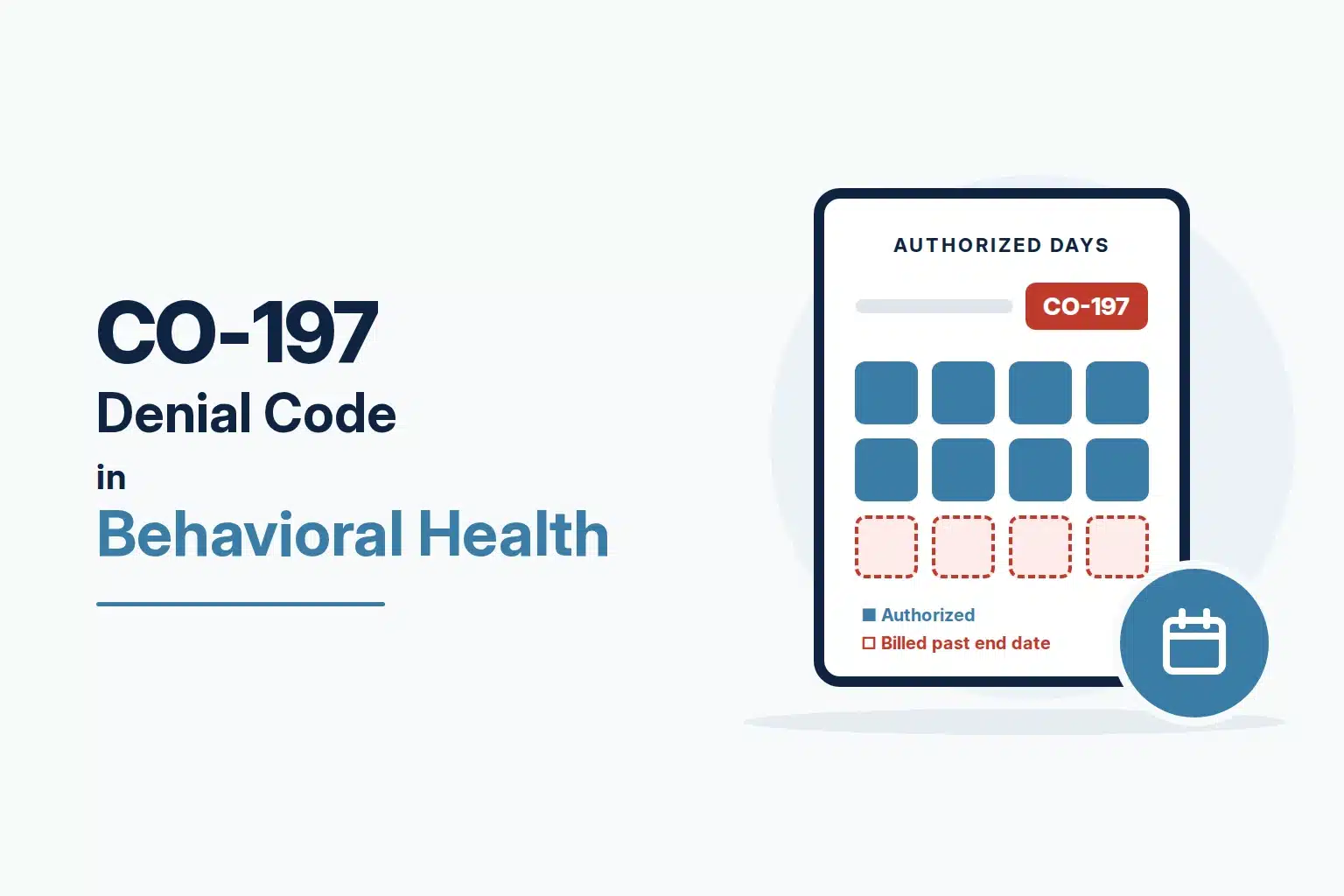
| Days past the end date | Care continued after the last authorized day and no extension was approved | Request an extension or retro authorization; appeal if refused |
| Level of care changed | Patient stepped down from PHP to IOP, but the new level was never authorized | Obtain authorization for the new level; correct the claim |
| Wrong provider identifier | Authorization sits under a different NPI, TIN or facility location than the claim | Ask the payer to correct the authorization record, then resubmit |
| Carve-out entity missed | The medical plan was called, but a behavioral health vendor holds the authorization | Contact the carve-out entity; request retro authorization |
| Retro authorization not requested in time | A situation that needed retro authorization was not caught quickly | Request retro authorization as soon as it is identified |
The carve-out row is easy to miss because the call to the payer did happen; it just went to the wrong entity. During verification of benefits, CodeMax calls the insurance company to confirm whether pre-authorization is required. If the policy is carved out, the team also contacts the carve-out insurer to confirm its authorization requirements. Our insurance verification guide covers that step.

The two situations that lead to retro authorization
Retro authorization, or retroactive authorization, is approval a payer gives after care has already started or been delivered, for a service that normally needed approval in advance. Payers decide each request individually and set their own deadlines. It is sometimes approved and never guaranteed, so it works as a recovery step, not a plan.
CodeMax’s utilization review team sees two common situations that lead to retro authorization requests:
- Late notice of admission: the billing or UR team is not told about an admission right away, so the request goes in after treatment has started.
- Coverage that became active mid-treatment: the patient’s policy was inactive at admission and was reinstated after treatment began.
In either case, contact the payer as soon as the gap is found. Ask whether the plan allows retro authorization for that service and what its deadline is. CodeMax’s benefits verification does not ask this in advance, because the answer only matters once a gap exists. Send the clinical documentation for the dates in question.
How to fix a CO-197 that already landed
The right fix depends on one question: did a valid authorization exist for the billed dates and level of care? Work through these steps in order:
- Pull the authorization record and compare it line by line with the claim: dates, level of care, units, NPI, TIN and location.
- If the authorization was valid and the claim was wrong, submit a corrected claim (frequency code 7) with the right authorization number and dates.
- If the authorization record itself is wrong, ask the payer to fix it, then resubmit.
- If no authorization existed, request retro authorization.
- If retro authorization is refused, file an appeal with the clinical records and an explanation of why authorization was late.
Stopping the drift before the claim goes out
Preventing CO-197 in behavioral health means checking the authorization at every point where it can drift from the service delivered, not only at admission. The first check is benefits verification before admission, including any carve-out entity that manages behavioral health benefits. The second is every concurrent review: confirm the new end date and authorized days are recorded where billing can see them. The third is every level-of-care change, such as residential to PHP or PHP to IOP, which needs its own authorization. The fourth is any change to the patient’s coverage during the stay, such as a reinstated policy. A facility that checks only at admission will find most mismatches on the remittance, weeks later. If the patient is covered under a single case agreement, check what the agreement says about continued-stay review too.
Final Thoughts
CO-197 reads like an accusation that nobody asked for approval. In a behavioral health stay, the more common story is that someone did ask, and the approval quietly stopped matching the claim as the stay moved on.
That changes where the work goes. The first call at admission matters, but so does every review, every step-down and every coverage change after it. The facilities that see fewer CO-197 denials are the ones where someone is watching the authorization for the whole stay, not just the first day.
Stop CO-197 before the claim goes out. CodeMax verifies benefits and authorization requirements before admission, including carve-out insurers, and our utilization management team handles initial and continued-stay authorizations through each review. Call 866-263-3629 or email info@codemaxmb.com.
You can also speak to a specialist about your authorization workflow.
Frequently Asked Questions
A CO-197 denial cannot be billed to the patient. The CO group code means the adjustment is the provider's contractual obligation. X12 guidance says payers should use the PR group code when the patient is responsible. If the remittance shows PR-197 instead, check the plan terms before billing the patient.
A single case agreement does not automatically replace authorization. An SCA sets the terms for one out-of-network patient, and its authorization terms should state whether continued-stay review still applies and on what schedule. Read those terms before admission so authorization requests continue on time.
A CO-197 on a service that needed no authorization may be a payer processing error. Pull the benefits verification record showing that no authorization was required for that service and level of care. Ask the payer to reprocess the claim, and appeal with that record if they decline.
CO-197 means no approval matches the billed service. CO-198 means an approval exists but the billed days, units or dates exceed it. In behavioral health, days billed past an authorized end date can come back under either code depending on the payer, so read the remark code before acting.